In the realm of truck accidents, the battle between proving brake failure and driver error in jackknife accidents becomes a pivotal point of contention. Dive into this comprehensive guide that sheds light on the nuances of these incidents, offering a unique perspective that captures the essence of the legal intricacies involved.
Exploring the causes, challenges, and evidence required, this exploration delves deep into the heart of jackknife accidents to provide a compelling narrative that is as informative as it is engaging.
Understanding Jackknife Accidents
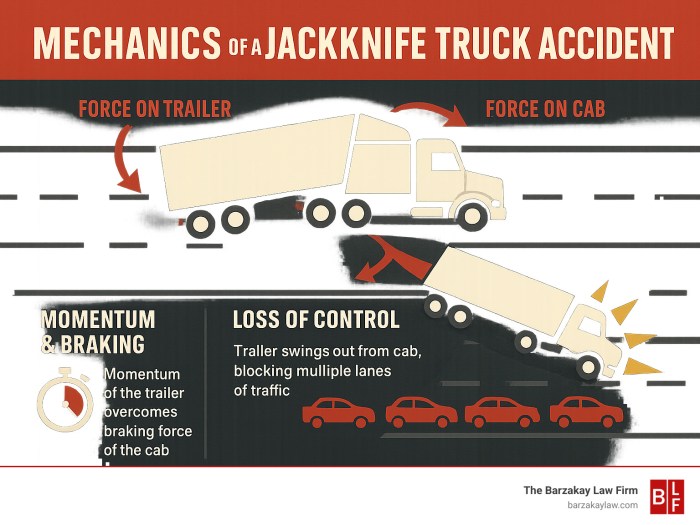
In the context of truck accidents, a jackknife accident occurs when a large truck, such as a tractor-trailer, skids and the trailer swings out to form a 90-degree angle with the cab of the truck. This type of accident is extremely dangerous and can result in serious injuries and fatalities.
Differentiating Jackknife Accidents
- Jackknife Accident: Involves the trailer swinging out to form a 90-degree angle with the cab.
- Rollover Accident: Occurs when a truck tips over onto its side.
- Rear-End Collision: Happens when a truck collides with the vehicle in front of it.
Mechanics of Jackknife Accidents
Jackknife accidents typically occur when the truck's wheels lock up, causing the trailer to swing out uncontrollably. This can happen due to various factors such as sudden braking, slippery roads, or equipment failure. The weight distribution of the cargo and the speed of the truck also play a significant role in the occurrence of jackknife accidents.
Causes of Jackknife Accidents
Jackknife accidents can be caused by a variety of factors, with two common causes being brake failure and driver error.
Brake Failure
Brake failure is a significant factor that can lead to jackknife accidents. When a truck's brakes malfunction or fail to engage properly, the trailer may continue to move forward while the cab slows down, causing the trailer to swing out and potentially fold in on itself, resulting in a jackknife position.
Driver Error
Driver error, such as sudden braking or steering, can also contribute to jackknife accidents. Abrupt actions by the driver, especially in emergency situations, can destabilize the vehicle and cause the trailer to swing out of alignment with the cab, leading to a jackknife scenario.
Proving Brake Failure
When it comes to proving brake failure as the cause of a jackknife accident, it is crucial to gather solid evidence to support this claim. This evidence will play a key role in establishing liability and seeking compensation for the damages incurred.
Evidence of Brake Failure
- Brake maintenance records: Detailed maintenance records showing regular inspections and repairs can indicate whether the brakes were in proper working condition at the time of the accident.
- Brake system inspection: A thorough inspection of the brake system by an expert mechanic can reveal any issues or malfunctions that may have contributed to the failure.
- Brake system components: Examination of brake components such as brake pads, rotors, calipers, and brake lines can provide insight into the condition of the braking system.
- Black box data: Data from the vehicle's event data recorder (EDR) or black box can offer valuable information about the vehicle's speed, braking patterns, and any malfunctions detected by the system.
Role of Expert Witnesses
Expert witnesses play a crucial role in proving brake failure in a legal case. These individuals, often mechanics or engineers specializing in vehicle systems, can provide professional opinions based on their expertise and experience. They can analyze the evidence, testify in court, and help the jury understand complex technical details related to brake systems.
Their testimony can significantly impact the outcome of the case and strengthen the argument for brake failure as the cause of the jackknife accident.
Proving Driver Error
When it comes to proving driver error as the cause of a jackknife accident, it involves a thorough investigation and analysis of the circumstances leading up to the accident. This process requires examining the driver's actions, decisions, and adherence to traffic laws and regulations.
Types of Driver Errors
- Speeding: Driving at excessive speeds can lead to loss of control, especially when braking suddenly.
- Distracted Driving: Taking attention away from the road, whether due to phone use, eating, or other distractions, can result in a lack of focus on driving tasks.
- Aggressive Driving: Tailgating, sudden lane changes, and other aggressive behaviors can increase the risk of a jackknife accident.
Challenges in Proving Driver Error
- Subjectivity: Proving driver error can be challenging as it often involves subjective assessments of the driver's actions.
- Lack of Evidence: In some cases, there may be a lack of concrete evidence to definitively prove that driver error was the cause of the accident.
- Conflicting Testimonies: Conflicting testimonies from witnesses or involved parties can make it difficult to establish driver error beyond a reasonable doubt.
Conclusive Thoughts
As we conclude our journey through the complexities of jackknife accidents, the juxtaposition of brake failure and driver error reveals a multifaceted landscape that demands expertise and diligence. This discussion serves as a reminder of the importance of thorough investigation and legal representation in the face of such challenging cases.
FAQs
What are the key differences between a jackknife accident and other types of truck accidents?
In a jackknife accident, the truck and trailer fold into a V-shape, unlike other accidents where the vehicle may overturn or collide with other vehicles.
How can brake failure contribute to a jackknife accident?
Brake failure can cause the wheels of the truck to lock up, leading to a loss of control and potential jackknifing of the vehicle.
What role do expert witnesses play in proving brake failure in a legal case?
Expert witnesses can provide specialized knowledge to help establish the presence of brake failure through technical analysis and testimony.
What steps are involved in proving driver error as the cause of a jackknife accident?
Proving driver error typically involves reconstructing the events leading up to the accident, analyzing driving behavior, and presenting compelling evidence.