
Delving into the realm of Social Media and Your Legal Claim: Why Posting Can Destroy Your Settlement, this piece aims to captivate readers with a thought-provoking exploration that sheds light on the intricate relationship between social media and legal outcomes.
The following paragraph will provide a comprehensive overview of the topic, highlighting key points and potential implications.
Introduction to Social Media and Legal Claims
In today's digital age, social media has become a powerful tool for communication and expression. However, when it comes to legal claims, the relationship between social media and legal proceedings can be complex and significant.Social media posts have the potential to impact legal settlements in various ways.
Information shared on social platforms can be used as evidence in court cases, affecting the outcome of a claim. Posts, photos, and videos can be misconstrued or taken out of context, leading to misunderstandings or misinterpretations that may harm a legal case.
Examples of Cases
- In a personal injury case, a plaintiff claimed to have suffered severe physical injuries that limited their mobility. However, the defendant's legal team discovered photos on the plaintiff's social media accounts showing them engaging in physical activities that contradicted their claims, resulting in a reduced settlement.
- In a divorce proceeding, social media posts showcasing extravagant purchases and lavish vacations by one party were used as evidence to challenge their financial claims, leading to adjustments in the settlement.
- In a defamation case, a defendant's social media posts containing false or damaging statements about the plaintiff were presented as evidence, influencing the court's decision and resulting in a substantial settlement in favor of the plaintiff.
Risks of Posting on Social Media During Legal Proceedings
When involved in a legal claim, posting on social media can pose significant risks that could potentially harm your case. It is crucial to understand how your online activity can impact the outcome of your legal proceedings.
Potential Risks of Posting on Social Media
- Social media posts can be used as evidence in court to contradict your claims or statements made during the legal process.
- Information shared on social media may be misconstrued or taken out of context, leading to misunderstandings that could be detrimental to your case.
- Posting about your legal claim or discussing details of the case online can violate confidentiality agreements and jeopardize the integrity of the proceedings.
Use of Social Media Posts as Evidence in Court
Social media posts are increasingly being used as evidence in court to support or challenge legal claims. Posts, photos, comments, and interactions on social platforms can provide valuable insights into a person's activities, state of mind, and credibility.
Importance of Privacy Settings and Admissible Content
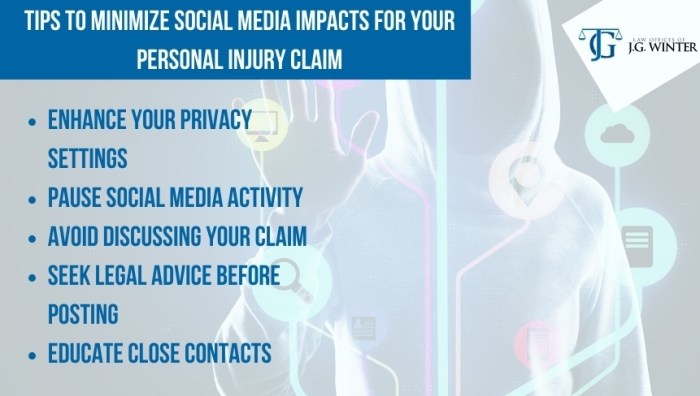
- Setting strict privacy settings on your social media accounts can help control who has access to your posts and limit the potential use of your content in court.
- While some content on social media may be considered inadmissible in court due to privacy concerns or relevance, public posts and information can still be used against you.
- It is essential to be mindful of what you post online during legal proceedings and avoid sharing any information that could be misconstrued or used against you by the opposing party.
Best Practices for Social Media Use During Legal Claims

When involved in legal proceedings, it is crucial to be mindful of your social media activity to avoid harming your case. Here are some best practices to follow:
Steps to Protect Yourself on Social Media
- Avoid discussing details of your case or making any references to ongoing legal matters.
- Review and adjust your privacy settings to control who can see your posts and information.
- Avoid posting any content that could be misinterpreted or used against you in court.
Tips on What to Share Online
- Stick to posting general updates about your life that are unrelated to your legal claim.
- Share content that reflects positively on your character and credibility.
- Consider refraining from posting altogether during the duration of your legal proceedings.
Monitoring Social Media Activity
During legal claims, it is common for opposing parties to monitor your social media activity. Here are some ways this can be done:
- Tracking public posts and interactions related to your case.
- Using social media evidence to challenge your claims or credibility in court.
- Hiring investigators to gather information from your social media accounts.
Case Studies and Examples
In this section, we will delve into real-life case studies where social media posts have impacted legal claims, compare outcomes of cases where social media was a factor versus cases where it was not, and discuss the role of social media investigations in legal proceedings.
Case Study 1: The Impact of Social Media on a Personal Injury Claim
- A woman involved in a car accident claimed she suffered severe injuries, but her social media posts showed her engaging in physically demanding activities.
- The insurance company used these posts to dispute the extent of her injuries, leading to a much lower settlement offer.
- Outcome: The case was settled for significantly less than initially anticipated due to the damaging social media evidence.
Case Study 2: Social Media Investigations in a Divorce Case
- In a divorce proceeding, one spouse claimed financial hardship and inability to pay alimony.
- An investigation revealed lavish spending habits and luxury vacations showcased on social media.
- Comparison: Cases where social media investigations were conducted led to more accurate financial assessments and fairer settlements.
The Role of Social Media Investigations in Criminal Cases
- In criminal cases, social media investigations have been crucial in establishing alibis or proving guilt.
- Prosecutors have used social media posts as evidence of criminal activity, leading to convictions.
- Example: In a burglary case, the defendant's social media post at the scene of the crime played a significant role in the conviction.
Last Point
In conclusion, this discussion has unveiled the critical role that social media plays in legal proceedings and the potential risks it poses to legal claims. By understanding the impact of social media on settlements, individuals can navigate this digital landscape more effectively.
Top FAQs
Can social media posts really affect legal settlements??
Yes, social media posts can impact legal outcomes by providing evidence that can be used in court proceedings. It is crucial to be cautious about what you post online during a legal claim.
What steps can individuals take to protect themselves on social media during legal proceedings?
Individuals should adjust their privacy settings, refrain from discussing the case online, and avoid sharing potentially damaging content that could be used against them.
How can social media activity be monitored during a legal claim?
Legal teams often conduct investigations into social media activity to gather evidence that can support their case. It is essential to be mindful of what you post and how it can be interpreted in a legal context.